Second Quarter 2026: S&P 500 Sector Allocation, Technology Concentration and Portfolio Balance

The second quarter produced good returns across nearly all areas, with particularly strong performance from the small-cap and mid-cap managers. While technology companies continued to lead the headlines, gains broadened beyond the mega-tech names… a healthy sign for longer-term stability and a reminder of the value of portfolio diversification when market leadership begins to broaden.
Technology remains the dominant theme this decade as Artificial Intelligence begins to reshape the economy. Supported by a lot of excitement, AI comes with the reality of building data centers, manufacturing advanced chips, and securing sufficient energy and infrastructure to support that growth. These AI infrastructure investment risks are practical, not theoretical. The inevitable headlines about supply constraints, delays, and construction challenges will likely provide speed bumps in the AI race.
With all of this innovation underway, there is little doubt that tech continues to deserve a significant (and growing) place in a diversified portfolio. The question is: How much? To help answer that question, we compare technology’s footprint in the U.S. economy with its representation in the stock market. That comparison also provides useful context for today’s S&P 500 concentration and the increasingly large role technology plays in overall market performance. We also examine the balance between growth companies positioned for the future and established businesses with solid cash-flow today.
Technology’s Economic Footprint and S&P 500 Sector Allocation
A balanced portfolio can be structured to align with the shape of the economy today or it can be positioned for what the economy may look like years from now. We believe that the correct approach is somewhere in between. This keeps the program diversified without having too much concentration in one sector. And, technology has indirect reach into other sectors, so it is a healthy blend.
The U.S. Gross Domestic Product (GDP), or economic output, defines the shape of the economy now, while sector stock prices reflect investors’ expectations for the future. Comparing the two provides insight into how today’s economy differs from what investors expect to emerge. We reorganized GDP data into investment-oriented categories to show the economy as it exists today, with tech at the top at 20%. This framework also makes it easier to compare economic activity with S&P 500 sector allocation, even though the categories do not line up perfectly.
How the U.S. Economy Breaks Down by Sector
|
Sector |
Share of GDP |
|
Technology |
20% |
|
Financials / Real Estate |
20% |
|
Industrials / Transport |
14% |
|
Consumer |
14% |
|
Government |
11% |
|
Healthcare |
8% |
|
Energy / Materials |
6% |
|
Other |
7% |
The sectors of the S&P 500 have roughly aligned with the breakdown of the GDP over the years. However, the weighting is currently out of sync, with tech weighing in at 45% in the S&P 500, much larger than the 20% in the GDP. Using our broader investment-oriented grouping of technology and technology-related businesses, that gap illustrates just how significant market concentration has become. The stock market is clearly signaling that investors expect U.S. technology companies to generate a disproportionately large share of future corporate earnings.
To provide some overall scale, U.S. GDP is about $32 trillion, of which more than $6 trillion is technology-related. Other nations are pursuing similar technology strategies (although on a smaller scale). So far, betting on U.S. tech has won by a long shot. That success is one reason the S&P 500 technology weighting has grown so dramatically, but past leadership does not eliminate the risks that come with allowing any single investment theme to become too dominant.
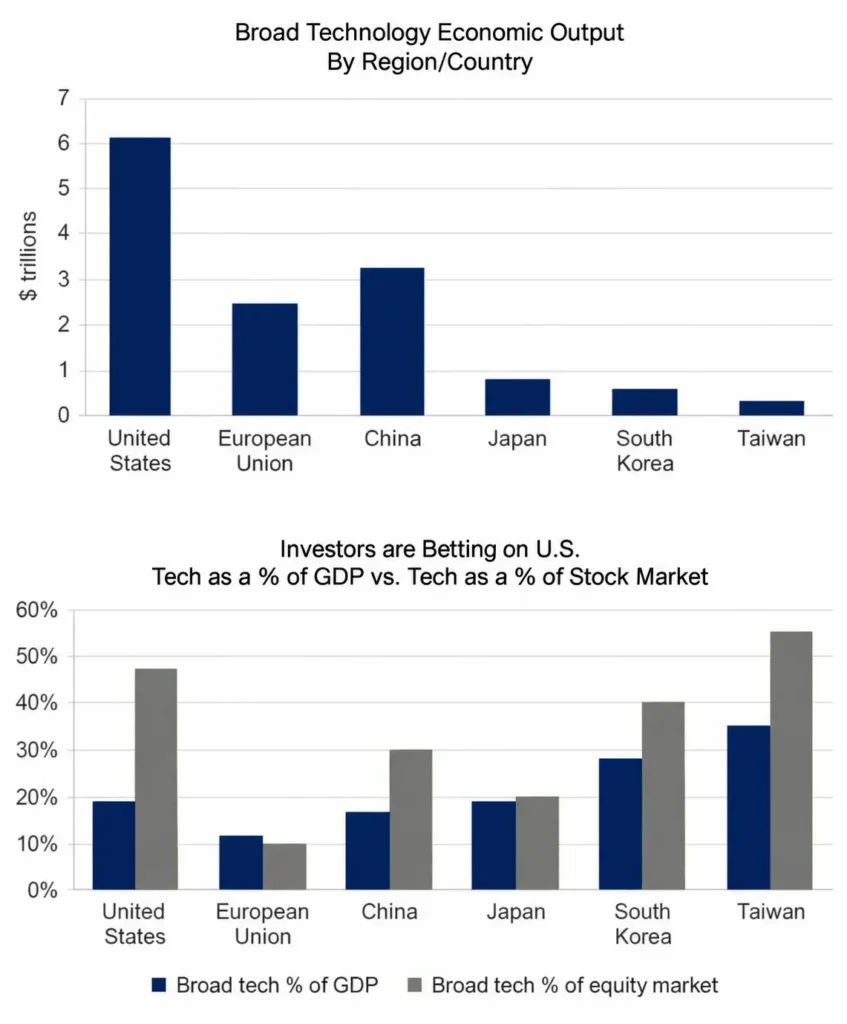
Our typical U.S. equity exposure meets in the middle at 27% technology… a little heavier than the current economy, but lighter than the S&P 500 weighting. This is an appropriate weighting because it recognizes the importance and long-term potential of technology, without allowing a single investment theme to dominate the portfolio. In other words, we want meaningful participation in technology’s growth while still managing portfolio concentration risk.
Value vs. Growth Investing: Participating in Today and Tomorrow
Our goal is not to choose between today’s economy and tomorrow’s opportunities, but to participate in both. We accomplish that through a combination of value and growth investments. This approach takes into consideration that some sectors are more fairly-valued based on current earnings (value), while some are justifiably higher based on potential earnings (growth). We achieve balance by including managers with different perspectives.
One of the core value managers we have invested in for decades is Oakmark Fund. Led by longtime manager Bill Nygren, Oakmark has earned a reputation as one of the premier value managers in the industry, focusing on high-quality businesses that trade at attractive valuations.
At the other end of the spectrum, TCW Concentrated Large Growth, also a portfolio position for decades, is an outstanding growth manager. TCW focuses on a select group of companies with strong competitive positions and the potential for above-average earnings growth over time.
|
TCW Concentrated Large Growth |
Oakmark Fund |
|
|
Category |
U.S. Fund Large Growth |
U.S. Fund Large Value |
|
5-year Average Return |
15.1% |
16.6% |
|
Number of Holdings |
30 |
59 |
|
PE Ratio |
30.2 |
12.2 |
|
Average Market Cap |
$850 billion |
$61 billion |
|
Size of Fund |
$680 million |
$24.3 billion |
|
Top Holdings |
NVIDIA, Google, Microsoft |
Targa, Conoco, Merck |
The portfolios of these managers are strikingly different. Oakmark’s large allocation (37%) to Financial Services reflects a classic value approach. Many financial companies generate substantial earnings and cash-flow today and are usually much cheaper per dollar of earning power vs. “growthier” areas such as tech companies. This is one reason value vs. growth investing is not simply a question of which style is “better.” Each approach responds differently to valuations, expectations and changing market conditions.
TCW’s larger allocation to Technology (53%) reflects a growth-oriented philosophy. Investors in growth companies are often willing to pay higher stock prices because they expect future earnings to be significantly larger than current earnings. The investment decision depends more heavily on what a company can become over the next decade than what it earns today.
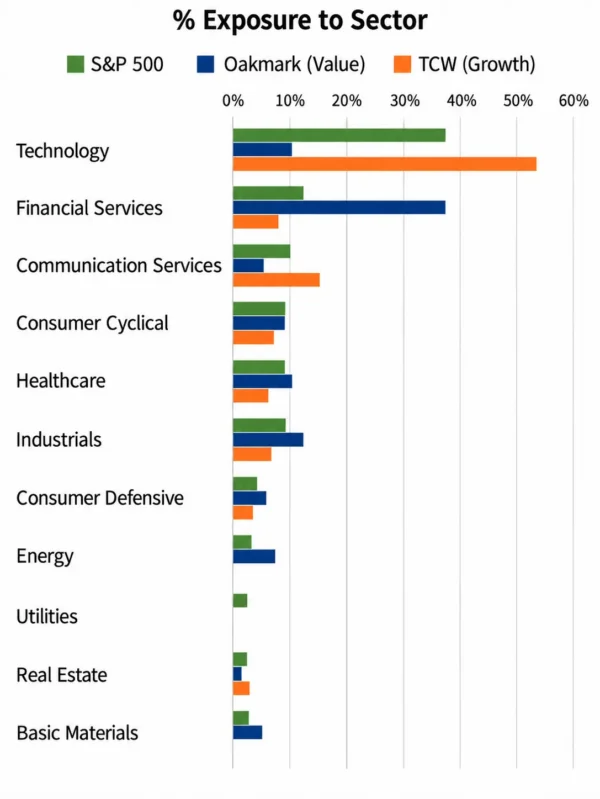
Over a full market cycle, value and growth often take turns leading. Growth tends to outperform when investors feel good and are focused on future earnings expansion. Value tends to outperform when investors are a little more concerned, placing greater emphasis on current earnings, cash-flow, dividends, and reasonable stock prices. Holding both allows a diversified equity portfolio to participate across different market environments rather than depending on one style remaining in favor.
Coming out of the dot-com era, which introduced a period of lower returns in the U.S., Oakmark Fund excelled. Over the past decade, TCW has excelled. Both funds have served their differing roles in the portfolio well.
Other core funds, such as the Schwab Fundamental Large-Cap Index, help to round out U.S. equities. Schwab Fundamental has all the merits of an index fund but is structured to eliminate disproportionate weightings caused by high stock prices (i.e. the mega-tech issue in the S&P 500). Accordingly, this fund is outperforming the S&P 500 this year. It also gives us another way to participate in U.S. equities without simply accepting the market-cap-driven concentration built into the traditional S&P 500.
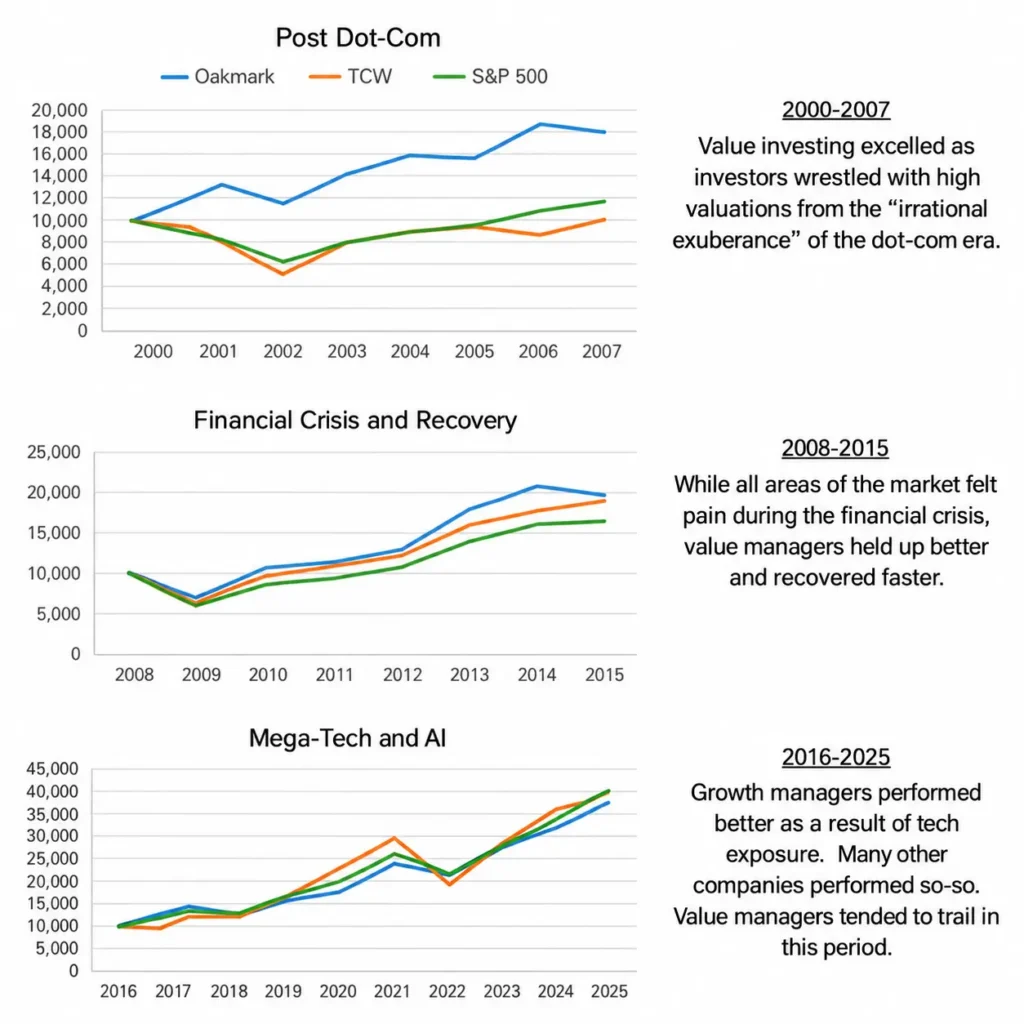
How Value and Growth Leadership Has Changed Across Market Cycles
|
Post Dot-Com |
2000-2007 Value investing excelled as investors wrestled with high valuations from the “irrational exuberance” of the dot-com era. |
|
Financial Crisis and Recovery |
2008-2015 While all areas of the market felt pain during the financial crisis, value managers held up better and recovered faster. |
|
Mega-Tech and AI |
2016-2025 Growth managers performed better as a result of tech exposure. Many other companies performed so-so. Value managers tended to trail in this period. |
Value, Growth, Balance and Discipline in a Concentrated Market
You may notice that our quarterly discussions arrive at similar conclusions. That is not because we have run out of things to say. It is because our investment philosophy remains consistent. These messages are timely now because they are always timely. Market concentration, AI, interest rates and investor sentiment may change the conversation from quarter to quarter, but they do not change the principles underneath a well-diversified portfolio. We will keep up the effort and stick with the discipline to continue your financial success!
|
Quarter |
Primary Topic |
Investment Principle Reinforced |
|
Q1 2024 |
Higher interest rates, bonds, and the Magnificent Seven |
Maintain balance. Diversification becomes more important when one area of the market dominates. |
|
Q2 2024 |
Inflation, consumers, and valuation |
Valuation always matters. Great businesses should still be purchased at reasonable prices. |
|
Q3 2024 |
Changing market leadership |
Diversification over concentration. Market leadership changes over time. |
|
Q4 2024 |
Influence of Artificial Intelligence |
Embrace innovation, but thoughtfully. Innovation deserves meaningful exposure, but not at any price. |
|
Q1 2025 |
Tariffs and market uncertainty |
Stay disciplined. Build portfolios before volatility, not in response to it. |
|
Q2 2025 |
Investor sentiment |
Avoid emotional investing. Headlines change faster than long-term fundamentals. |
|
Q3 2025 |
Magnitude of Artificial Intelligence |
Balance today’s economy with tomorrow’s opportunities. |
|
Q4 2025 |
Looking back at market cycles |
Investment principles endure. Diversification, valuation, and patience continue to work. |
|
Q1 2026 |
Oil, geopolitical events, and AI |
Focus on long-term fundamentals. Temporary events rarely justify changing long-term strategy. |
Best wishes for a pleasant and relaxing summer!